
Lower School 4s-7s

The early lower school program at Greene Hill provides young children with opportunities to engage creatively with each other, and with a variety of materials. Great emphasis is placed on learning about what it means to be part of a classroom community, and finding joy in learning and exploring together.
4s - 7s Curriculum
-
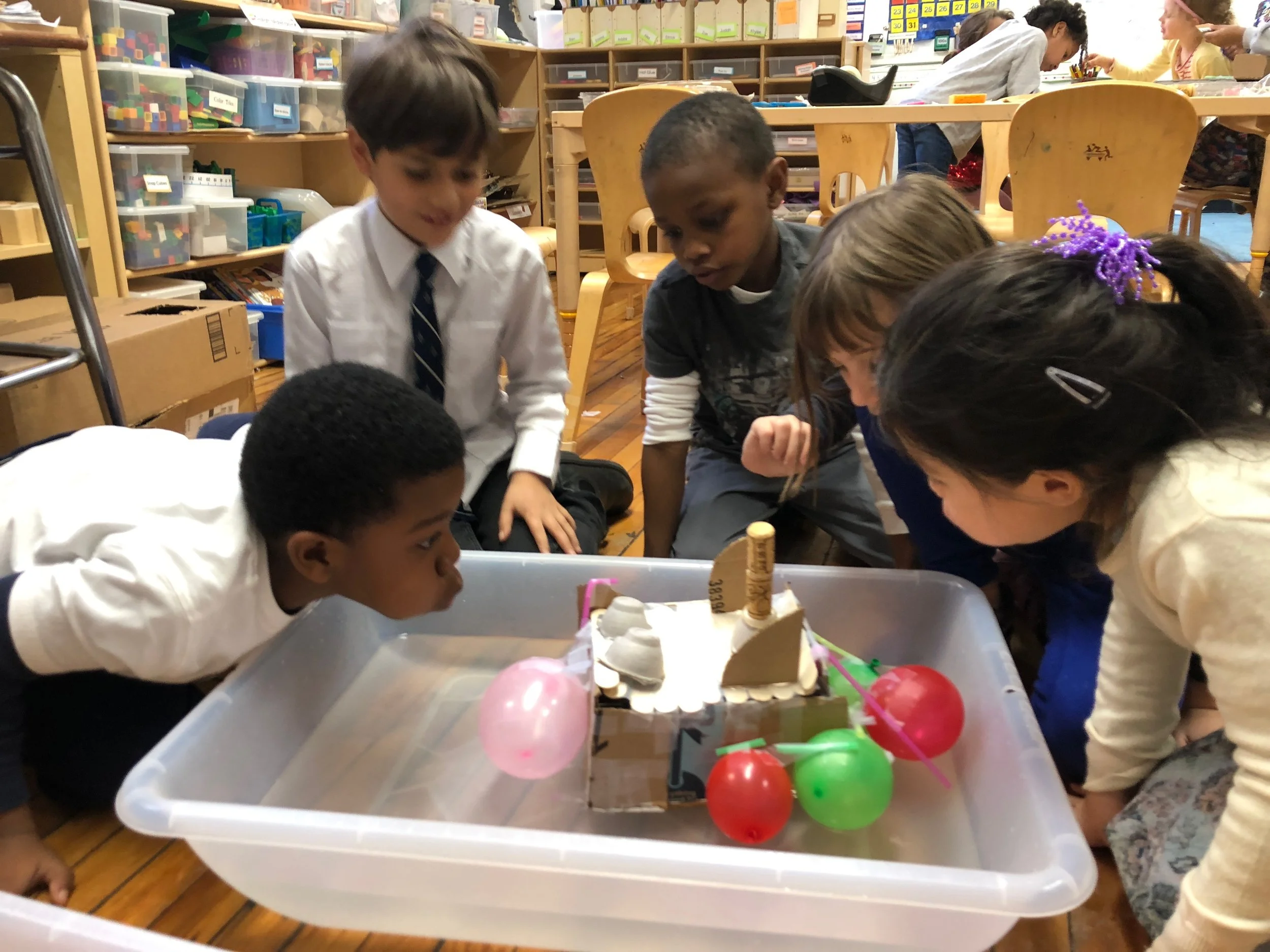
A daily opportunity for children to engage in self-initiated work with a range of materials.
-

Children are immersed in experiences that help them better understand their communities and environments.
-

We approach the teaching of reading and writing joyously and intentionally.
-

Students begin to explore mathematical concepts through sorting, classifying, and grouping objects, as well as work with patterns and shapes.
-
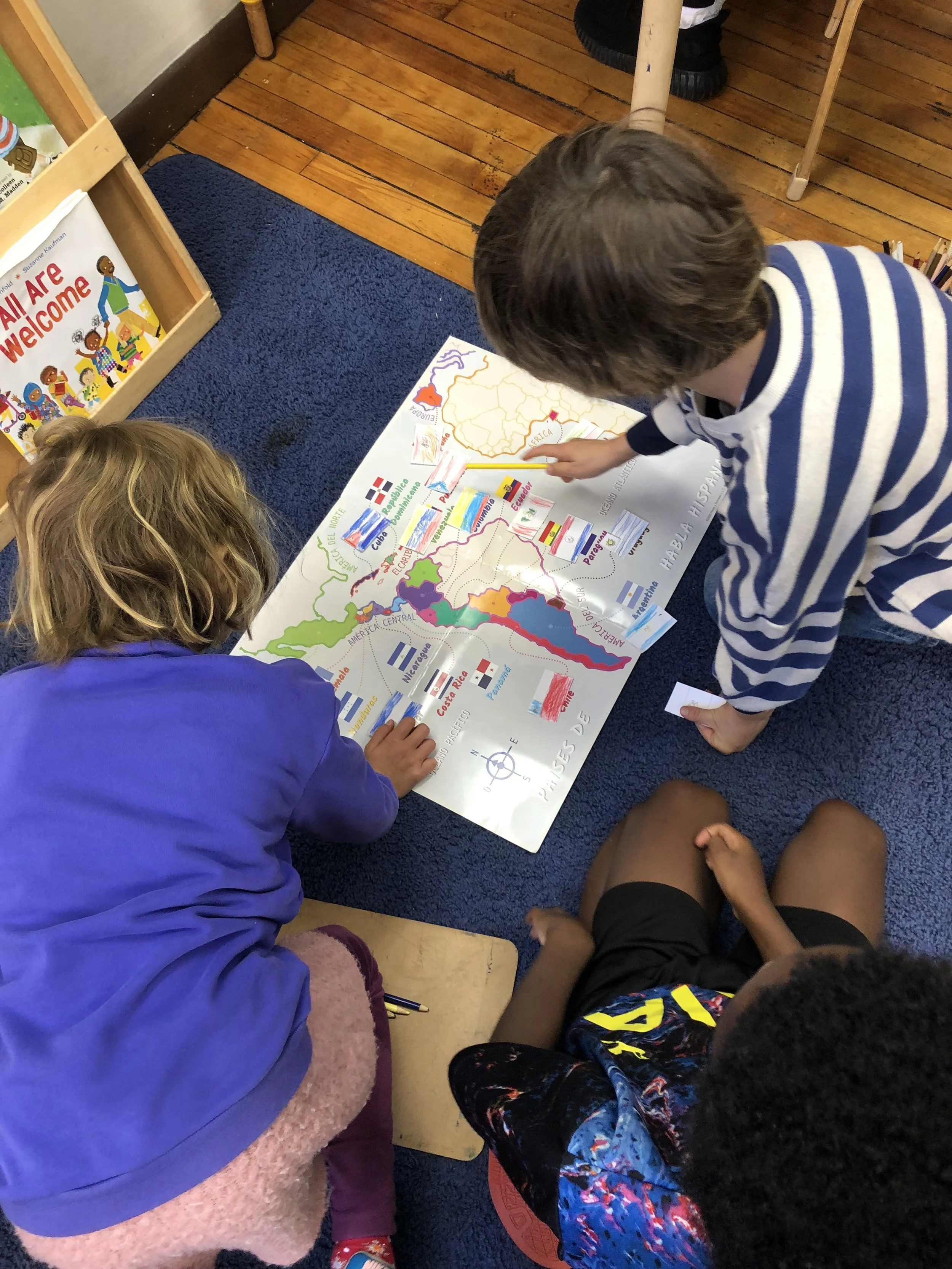
Spanish instruction in the Lower School is designed to be fun and to encourage risk-taking for those learning a new language.
-

Music, Drama, Visual Arts, Movement and other co-curricular activities are woven through all modes of learning.

Open Work
AGES 4 - 7
Open Work is a daily opportunity for children to engage in self-initiated work with a range of materials. In the 4s, the unit blocks, easel paints, sensory table, and clay are always available. Through extended experience with those open-ended materials, the children’s work develops in complex and often surprising ways. Students make discoveries about mixing colors or balancing tall buildings. They are deeply invested in the dramatic play that evolves around block buildings and clay, and tell elaborate stories to accompany their paintings or work at the water table. They move fluidly between materials and activities, finding opportunities to work independently or with peers. Most important, children experience the satisfaction of making their own choices and following their own ideas.
In the 5s and 6s classrooms, familiar materials continue to be available, while teachers add others, including a variety of art and building materials, curriculum-related explorations, and a woodworking station. Children learn to stay with their Open Work choices for longer stretches of time, beginning to return to work over several days. By the 7s year, students are proposing their own ideas for materials and explorations and engaging and teaching their classmates. Their repertoire expands to include activities like bookmaking, cardboard construction, science experimentation, and puppetry. The explorations and creations of Open Work in the early Lower School classrooms set the stage for continued self-initiated work throughout the upper grades, as children acquire the ability to manage more complicated projects. Encouraged to share their ideas with classmates, they become increasingly comfortable giving and receiving feedback and reflecting on their own work and process — skills that transfer readily to academic work.

Community Work
AGES 4 - 7
In the early years of the Lower School, Social Studies and Science work are deeply intertwined in the classrooms, as children are immersed in experiences that help them better understand their communities and environments. While certain studies may fall neatly into the categories of “Science” or “Social Studies,” at this age the connections among them are very strong, with most explorations highly integrated in nature. We call these core studies “Community Work.” Whole-class block building is an important arena for learning: children build realistic scaled models based on first-hand research, and then use their structures to deepen their experience through dramatic play and reenactment.
Greene Hill faculty work collaboratively and reflectively to craft curriculum each year, aligned with core learning concepts for each age group that take into consideration the interests and learning styles of each group of students as well as current events or other real-world learning opportunities, ensuring that students experience a rich, comprehensive curriculum over the course of their time at Greene Hill School. Specific learning objectives provide benchmarks for student progress in each content area and teachers use a range of formal and informal assessments to assess children’s learning and plan future studies.
-
With a yearlong learning theme of Self & Others, explorations of families, jobs, stories, and life cycles are typical studies the 4s pursue as they begin thinking about their place in school and their neighborhood and paying attention to the natural world. As children grow, first-hand experience continues to be integral to learning. Beginning with an Identity Study and continuing through the year, reading books about family, community, and children of different ages help the 4s consider their own experiences as well as their classmates. Children reflect about themselves as individuals and as members of their classroom community, as they look into what makes them “them.” A sense of community is learned by working together to care for their space, as teachers and children think about daily jobs that need to happen to help maintain the classroom. 4s use their knowledge of the jobs people have to further learn about different community helpers in the school neighborhood. Through these explorations of themselves and others, they learn how to be together as a group and, at the same time, how to notice and value each individual in the room.
-
In the 5s, Community Work encompasses topics related to Growth, as children develop deeper understandings of their changing selves as well as their urban and natural surroundings. In embracing their own growth, 5s are encouraged and supported as they develop more independence in both daily routines and care for the classroom and school, as well as in their work and maintaining relationships with others. The 5s’ study of trees, and the creatures that live in them, extends throughout the year alongside other work, and provides meaningful opportunities for children to explore the intricacies and diversity of natural life. Literature, science experiments, and visual artwork are all regular parts of the Tree Study, and seasonal aspects of this study align with students’ outdoor experiences in all types of weather. In the Spring, the 5s explore growth and life cycles through planting and growing seeds into plants, observing caterpillars change into butterflies (and setting the butterflies free in the school garden), and incubating and hatching chick eggs.
-
Community Work explorations in the 6s are locally themed. Children examine the yearlong concept of Community by investigating areas of their direct experience: their lives at home, their neighborhood, or their natural surroundings. During a “Block” Study, 6s learn about and visit businesses and community organizations in the commercial block around the school, exploring the ways in which people work together in various roles to accomplish complex tasks. For example, children may research the workings of restaurants through books, visits, and interviews, culminating in the creation of their own restaurant. In the spring, 6s typically study a class of vertebrate animals, such as birds or fish, both from a science and social studies perspective. Visits to places such as the East River or Prospect Park provide the chance to explore a local ecosystem, leading to a greater appreciation for how people and animals make use of their environment.
-
Through a yearlong study of Systems, 7s investigate familiar and tangible elements of their urban environment in new and more complex ways. By observing aspects of their immediate surroundings, becoming facile with maps, and visiting other parts of the city, students learn about how people and places are connected and better understand the complexities of their urban surroundings. 7s study neighborhoods through the perspective of needs and wants, gathering data and drawing conclusions about how neighborhoods do (or do not) meet the needs of their residents, what leads to inequity across neighborhoods, and ways to advocate for change. An in-depth study of the transportation system gives 7s a stronger geographic understanding of the five boroughs, as well as a chance to look at how this complex system evolved over time as the city expanded. Other historical aspects of city life are introduced as students consider how changing needs and wants of a population create change in places such as the Brooklyn Navy Yard or the High Line.
-
Develop a sense of identity and an awareness of the importance of diversity and inclusivity.
Develop conflict resolution skills and a sense of responsibility toward self and others.
Communicate needs and feelings clearly and with intention.
Acquire interviewing and recording skills.
Notice similarities and differences in people and places.
Recognize interdependence in a variety of contexts.
-
Use observation skills to generate questions.
Identify the needs of living things.
Explore changes in the natural environment through the seasons.
Understand how particular physical traits of animals affect their survival.
Compare and contrast animal species.
Explore concepts of architecture and design in person-made structures.
Begin to make logical inferences based on real-world experience.
-
What makes me who I am?
Who are the people in my life?
How do people take care of themselves and others?
How do people and other living things grow?
How does growth create change?
Who are the people and places in our community?
What communities do we see in nature?
How do people work together to accomplish complex jobs?
How are people and places connected to each other?
What do people and places need to flourish?
How do needs and wants change over time?
How do the needs, wants, and identities of people shape their neighborhood?

Literacy
AGES 4 - 7
At Greene Hill we approach the teaching of reading and writing joyously and intentionally, with knowledge of the science of reading development guiding our work with early readers. Expectations of children’s literacy skills are attuned to what we know about typical patterns of development and based on each child’s progress. Children progress through emergent literacy stages into becoming fluent, independent readers and writers, engaging with the written word with zest and confidence. Beginning in the 5s year, students participate in intensive small-group work according to their reading developmental level. Literature and comprehension skills and concepts are modeled and taught through read alouds and other shared texts, and practiced independently and in small groups as students become fluent readers. Children use writing across the curriculum as a means to form and communicate ideas; they also focus on particular genres of creative and informational writing. Strong phonemic and phonological awareness is developed through regular, engaging practice, and ongoing word study practice prioritizes phonics as students learn to identify and use predictable spelling patterns and rules, and work on committing certain high-frequency words to memory. Developing skills are assessed through teacher conferences and observations, periodic benchmark assessments for phonological development and reading, and checklists or rubrics specific to the writing genres they study.
-
Early literacy activities and experiences are embedded in the daily work of the 4s. Children listen to books read aloud, sometimes studying particular genres like fairytales, and share books with each other. Children tell each other stories that grow from communal play in the block area, or from a child’s painting. They use blank books to compose stories or record everything they know about someone or something close to their hearts. In the spring, we begin our Handwriting Without Tears program, which teaches proper pencil grip and letter formation, alongside a multi-week “Mystery Letter” study that introduces initial sounds through engaging activities and games. As their awareness of letters and sounds grows over the year, 4s begin sorting objects or pictures based on the first sound they hear, and some use those initial sounds to try writing words on their own. Much of this work takes place during Open Work and Choice Work times of the day, allowing students to come to literacy-based tasks on their own and to be supported by teachers to build their skills.
-
Explicit reading and writing instruction begins in the 5s. At the beginning of the year, children of this age already have a strong relationship with literature — they can retell familiar stories and use pictures and words to help them narrate favorite books. They use drawings to compose their own true and imagined tales. Classroom literacy routines include shared reading of both long and short texts to teach concepts of print and literature and comprehension skills, partner and independent “Book Looks,” phonological awareness and word study practice, and explicit whole-class and small group instruction. Small groups are focused on students’ reading development and emphasize teaching and practice of specific skills. Writing Workshop lessons help 5s become a community of writers using pictures and words to tell stories, label pictures, and write non-fiction. As the year progresses, 5s build knowledge of how written language works, and become increasingly skillful and independent as readers and writers.
-
Many 6s anticipate learning to read and write over the course of the year and have high expectations for themselves. Our literacy instruction builds a solid foundation so that 6s identify themselves as readers by emphasizing reading as something to love. This continues throughout the year through consistent and structured literacy routines that include reading workshop, writing workshop, small group work, word study, shared reading, and read-alouds. Small group reading work focuses on specific skills that align with students’ particular reading developmental stages. Phonological awareness practice continues in the 6s to solidify students’ knowledge of letters and sounds as they develop into independent readers. Students also engage in other word work practice and begin to learn spelling patterns and rules as well as continuing to build their sight word vocabulary. 6s write for a variety of purposes and are introduced to the writing process through guided practice in developing ideas, drafting, revising, and editing their work. 6s typically revisit familiar genres, gaining experience writing narrative fiction as well as informational pieces, and writing more expressively and playfully.
-
7s are increasingly fluent readers and writers, and will spend the year becoming more independent and skillful. Reading and writing are approached joyfully and pursued independently, but the class also develops strong community around literacy, forming discussion groups around shared books or series, or giving each other carefully considered feedback about written work. Students continue to refine their writing skills through more independence with the writing process, with a greater emphasis on revision for content and style. Writing is seen as purposeful, as a way to express ideas, and community-minded with frequent writing shares. Structures and routines for literacy in the 7s include shared reading and read alouds, word work practice to develop facility with common spelling patterns and rules as well as recognition of high-frequency words, focused small-group reading instruction with either a teacher or the Learning Specialist, and one-on-one conferences to provide guidance for students’ ongoing independent practice.
-
Make connections to stories and poems.
Observe predictable story elements in a genre like fairy tales.
Identify letters and recognize letter-sound correspondence.
Notice and generate rhyming words.
Recount and compose stories orally.
Use writing and drawing tools competently.
Stretch words to hear all sounds while writing.
Use inventive spelling to represent phonetic sounds.
Use conventions such as left-to-right orientation, spaces between words while building independent writing skills.
Integrate decoding and comprehension skills to read with purpose and meaning.
Recognize narrative arc of stories and incorporate in own compositions.
Use writing to capture a moment, or share ideas.
Recognize and use the conventions of a variety of genres.
Write sentences with beginning capitals and ending punctuation.
Use the writing process to generate ideas, draft, revise and edit, and share their writing.
-
Stories and their elements
Reading through pictures and words
Relationships between sounds, letters, and words
Text features and characteristics
Purposes for writing
Purposes of writing conventions
Similarities and differences between types of texts
Genres and formats for writing
Strategies for reading independently
Stamina
Author’s voice
Point of view
Mentor texts as models for writing

Math
AGES 4 - 7
Our Math curriculum is guided by a constructivist approach that provides children with hands-on experience through which they build mathematical understanding and skill. Students begin to explore mathematical concepts through sorting, classifying, and grouping objects, as well as work with patterns and shapes. Number recognition and counting skills (including one-to-one correspondence: the understanding that, when counting, each number said represents an object counted) occur in self-directed Open Work, choice, and play times as well as in purposefully planned Math activities and games in the classroom. Daily routines are a large part of Math work of younger students, where counting classmates in school or responses to a morning poll question such as “Are you wearing boots today?” provide data for students to analyze and discuss. Work with place value increases, and computation work begins formally in the 6s as students begin to work with addition and subtraction facts and construct number sentences to represent their mathematical thinking, with the support of a range of math tools and manipulatives. Games continue to be a frequent way that skills are practiced, and flexibility and engagement is a regular aspect of Math work in the classroom.
Students explore the distinct mathematical strands of number and operation, patterns and functions, data and probability, geometry, and measurement. Assessment of their mathematical skills and reasoning happens through daily teacher observations, analysis of children’s work, and performance assessments built into the curriculum. By emphasizing flexible thinking and connections, Greene Hill’s math program provides a foundation that allows students to continue to grow as problem-solvers and strategic thinkers in Math as well as other areas of their academic lives.
-
Whether building with blocks, preparing class snacks, or counting their classmates during morning circle time, children in the 4s are using numbers to make sense of their world. They begin to move beyond rote counting to a deeper understanding of numbers as representations of specific quantities. They use simple charts to represent data, and play games that involve sorting, classifying, comparing sizes and quantities, or identifying patterns.
-
The 5s math program introduces children to many of the materials, structures, and routines that they will be using throughout Lower School. Students use daily practices like studying the calendar and taking attendance to build number sense. The 5s work throughout the year to strengthen their number sense and fluency with counting and comparing numbers to 20. They refine counting skills, compare quantities, and add and subtract small numbers, using cubes or other math materials to make the work concrete. At the same time, 5s begin to use number sentences (equations) to represent computations with pencil and paper. They develop logical skills by sorting and classifying shapes according to different attributes, and by identifying and describing simple repeating patterns. Children design surveys and keep track of responses, learning to interpret real-world data.
-
Young mathematicians in the 6s are becoming comfortable working with numbers in authentic and also more abstract ways, acquiring a stronger understanding of the base-ten number system. Through teacher-modeled activities and lessons, games, and work with story problems, students’ work focuses on gaining an understanding of addition and subtraction, using numbers and notation to represent these operations, and finding different strategies for solving problems. 6s develop strategies for accurately counting a set of up to 50 objects by ones, and begin to count by groups. They also discover more real-world uses for measurement and data analysis, and continue to work with patterns, functions, and two- and three-dimensional shapes.
-
With stronger understanding of place value and increased fluency with basic math facts, 7s are becoming nimble with numbers and capable of more complex mathematical reasoning. Math work in the 7s continued to utilize familiar practices including games and partner work, but students’ growing independence provide for more individual work. 7s work on developing strategies to compute with two-digit numbers accurately, and develop estimation skills for addition and subtraction up to 1,000. 7s develop skills that set the stage for multiplication and fractions, like skip-counting and working with “things that come in groups.” 7s use their growing mathematical skills frequently throughout the curriculum, particularly as they gather data or investigate topics as part Community Work studies. Work continues with telling time, place value, coin combinations, and two- and three-dimensional shapes.
-
Develop strategies for accurately counting a
set of objects by ones, fives, and tens.
Use the concept of equivalence.
Use manipulatives, drawings, tools, and
notations to show strategies and solutions.
Construct, describe, and extend repeating patterns.
Carry out data investigations and represent data visually.
Describe, identify, compare, and sort two- and three-dimensional shapes.
Understand length and use linear units.
Make sense of strategies to solve addition and subtraction problems with small numbers.
Gain fluency with number combinations.
-
Shapes and patterns
Sharing and dividing materials
Sorting and categorizing
Purposeful use of math manipulatives
Solving problems in multiple ways
Mathematical symbols
Counting strategies
Representing mathematical thinking
Spanish
AGES 4 - 7
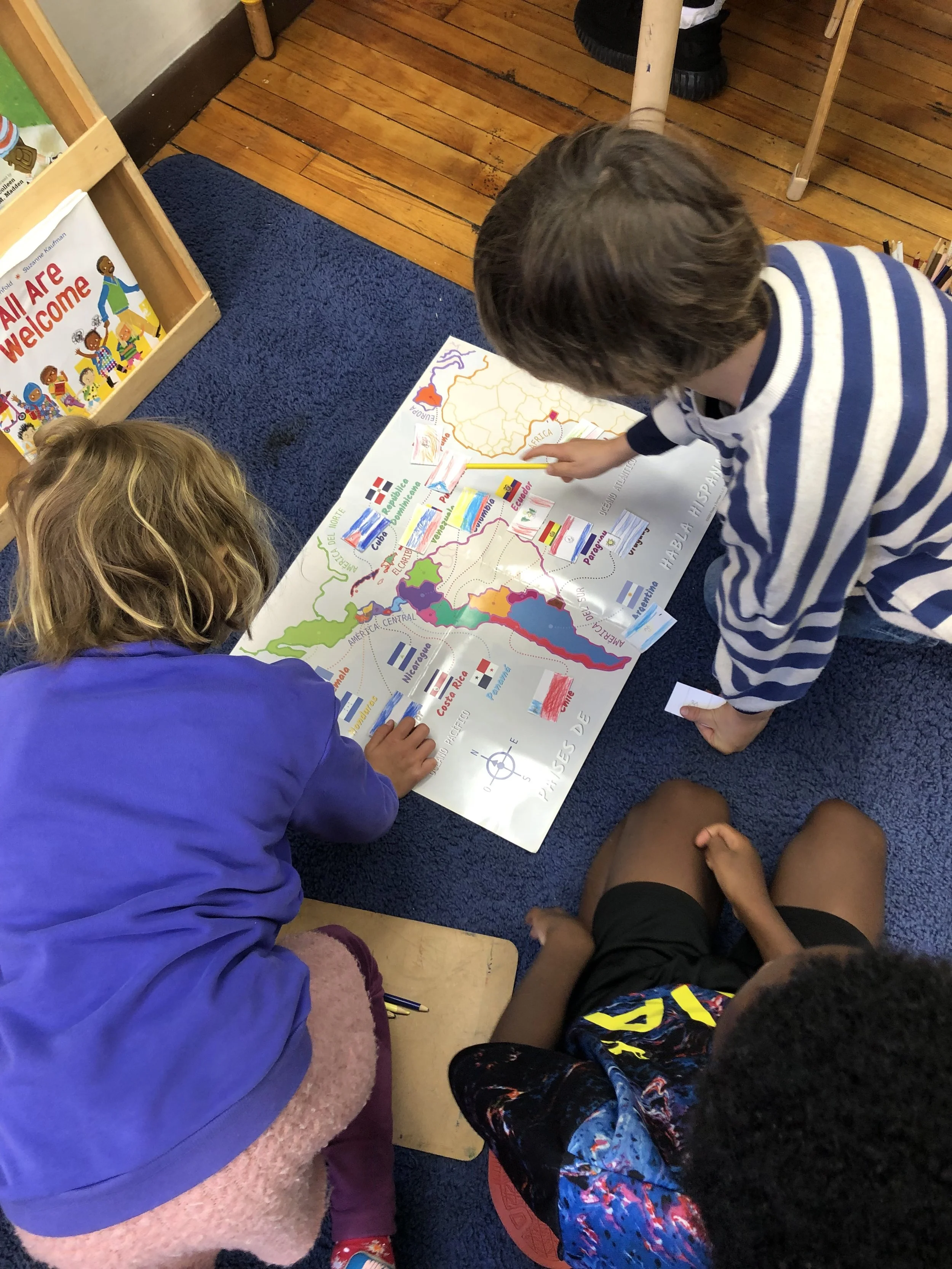
Spanish instruction in the Lower School is designed to be fun and to encourage risk-taking for those learning a new language as well as knowledge of and respect for Spanish-speaking cultures and an awareness of the prevalence of the Spanish language in New York City. All Lower School classes have twice weekly Spanish lessons. Our youngest students learn basic vocabulary and expressions, focusing on greetings, colors, numbers, the alphabet, the calendar, animals, the body, and food, through art, games, songs, literature, puppetry, and other interactive activities. In the upper grades, students continue to increase their Spanish vocabulary and conversational skills, incorporating more sophisticated content such as prepositions, adjectives, common verbs, and some present tense verb conjugations. More and more, they learn to use Spanish across other areas of their curriculum: solving math problems in Spanish, telling time, learning vocabulary that relates to Community Work and Social Studies topics. As their conversational skills grow, they begin to practice their writing skills. Students also learn more about Spanish-speaking countries and cultures around the world.